The moon and the stars: Ethan Hawke and director Richard Linklater talk friendship, pushing boundaries and the drama of Blue Moon
All the preparation in the world will not ready you for the surreal moment a previously unnoticed slide door opens, and Ethan Hawke steps through.
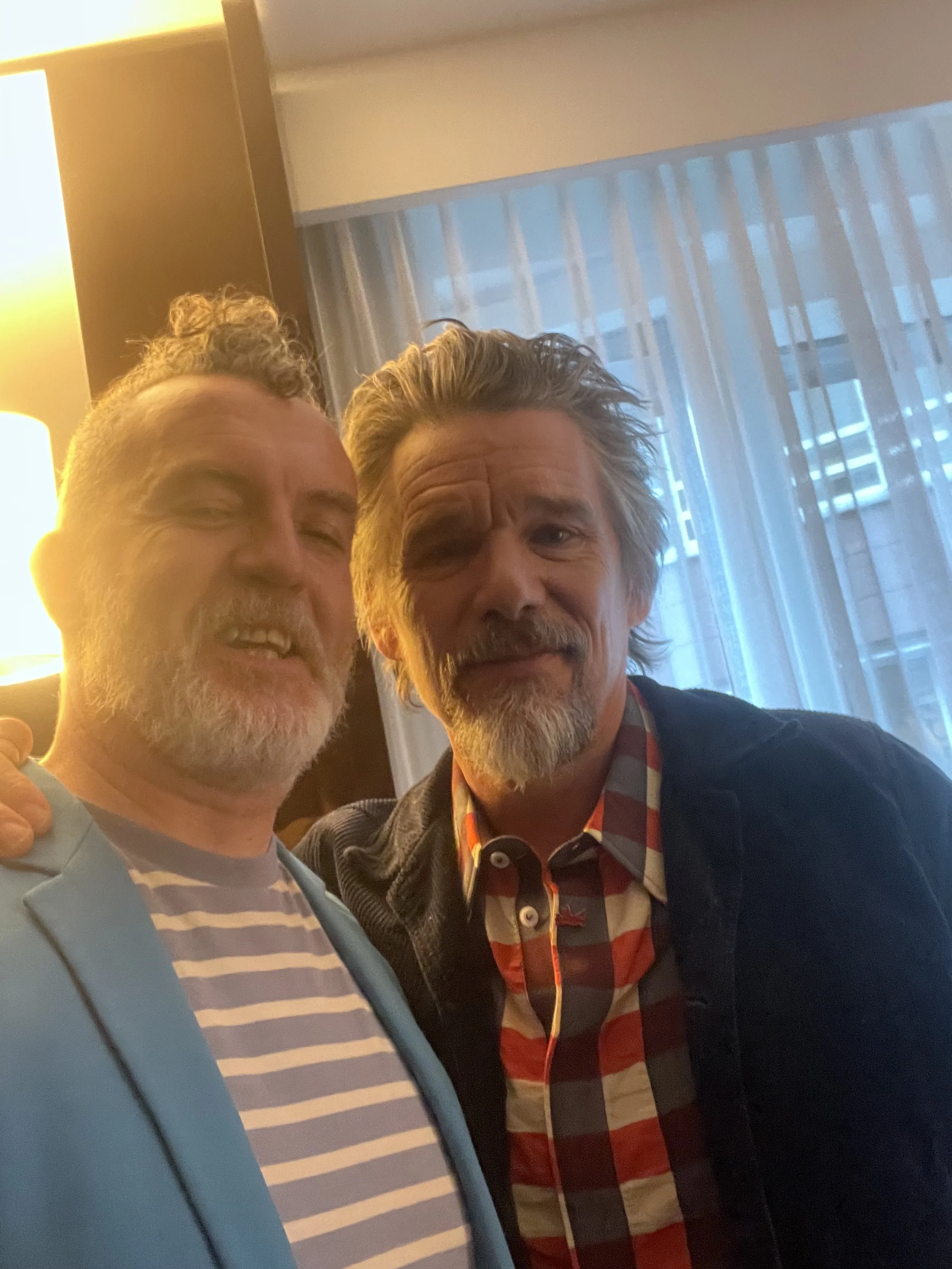
Photo by Stephen A. Russell
It’s Berlinale, and we’re squished into a boxy little room at the Grand Hyatt that’s not commensurate with the outsized impression Hawke has made on us since appearing in Peter Weir’s Dead Poets Society in 1989.
Wearing a checked shirt under a navy corduroy one, he’s sporting a thick mane of salt and pepper hair and a goatee. We’re here to talk about his multi-award-nominated new movie, Blue Moon, his latest collaboration with director Richard Linklater.
There’s nary a hint of the celebrity shield around Hawke. Then again, he’s never courted fame in quite the same way as it has courted him.
“Somebody said to me, ‘Gosh, Ethan, you’ve gotten so much older,’ and Rick [Linklater] replied, and I laughed, because it’s actually true, ‘He’s been dying to look like this his whole life,’” Hawke says, accompanied by a rumbling laugh.
“I was very uncomfortable with being objectified as pretty at the start of my career,” he adds. “But now I watch Before Sunrise and, fuck man, no wonder I got so much attention. But I was very uncomfortable with it. The characters I get to play now are so much richer and more interesting.”
Hawke’s rocking a very different look in Blue Moon. Set in a Broadway bar in 1943 on the night Oklahoma! opened, it features Hawke as all but forgotten lyricist, Lorenz Hart. All of Us Strangers star Andrew Scott is his once rock-solid creative partner, Richard Rodgers. But Hart’s been supplanted by Oscar Hammerstein II (Simon Delaney).
A combination of hair (or not), makeup, prosthetics and good old-fashioned camera trickery allows Hawke to disappear into Hart’s stooped stature. “This movie was demolishing my vanity,” he chuckles.
In that ego death, new possibilities arise. “Well, what if I was a foot shorter? How would I be different?” Hawke ponders. “Rick wanted to annihilate Ethan. You know, he would say that to me on set, ‘I saw Ethan in that take and I hated it.’ I knew exactly what he meant.
“Larry has a different kind of confidence than I do. People are really nice to me. People aren’t nice to Larry. They’re dismissive of him. He has to fight for his space.”
Hawke’s trust in Linklater allows him to push further. “I would do a take that I thought was great and he’d be like, ‘Nobody wants to see you think you’re so fucking clever,’” Hawke says. “I don’t know if I would have taken that level of criticism from somebody I didn’t know. But we’ve made nine movies together. Obviously he likes my acting, right?
“If I’m gonna be insecure with him, when am I gonna be secure?”
Shoot fast, go deep
From the first blush of youth in Dead Poets through Ben Stiller’s slacker comedy Reality Bites and on to the Before trilogy, Hawke’s first films with Linklater, and the monumental achievement of Boyhood, all these roles feel fully lived in.
“I met him when he was 23,” Linklater recalls when we meet in the same hotel a day later. “He was already a movie star. River Phoenix had passed away, so now, with every script, he’s the first choice. But he comes over to Vienna to work with me on this weird little thing [Before Sunrise] and not get paid. He was offered Independence Day but turned it down to do Gattaca with Andrew Niccol.”
By this stage, Hawke had already made his Broadway debut, in Anton Chekhov’s The Seagull opposite Laura Linney, directed the music video for Lisa Loeb’s 1994 hit ‘Stay (I Missed You)’ and published his first novel, The Hottest State. Just last week, footage hilariously cropped up of him roasting Rose Byrne for negatively reviewing The Hottest State on Goodreads during this year’s New York Film Critics’ Awards.
Blue Moon is attracting Oscars buzz, alongside Byrne’s If I Had Legs I’d Kick You.
“This is my Sidney Lumet film,” Linklater says, referencing the New York theatre-maker who turned to gritty filmmaking, including queer masterpiece Dog Day Afternoon. “I try to hide the cinema. It’s there, but we’re all here for the language.”
Shot in a startlingly fast 15 days, Blue Moon was no flash in the pan. Linklater’s been playing with the idea for almost a decade. He rehearsed it with Hawke for over a month.
“That’s a director’s job,” Linklater says. “What’s the tone? How’s this gonna work? What’s it gonna look and feel like? Then we shoot quick on a low budget.”
There are similarities with musical composition. “It’s a craft, but it’s also a gift,” Linklater says. “Rogers could write a song in ten minutes. The melody just flowed out of him. And Hart could write lyrics like that, too. They were such a good team.”
And then they weren’t. “There’s this intimacy of stolen conversations between them, and at one stage they’re about to make up, on the stairway,” Linklater says. “But there’s just too much scar tissue, too much past.”
Linklater watched old interviews with Rogers while researching the film. “There’s one from the 70s. Hart’s been dead 30-plus years, and there’s still love. He talks about Larry’s gift, his genius, but that relationship nearly broke him. He says, ‘Larry tried to kill me.’ I showed Andrew that, because it felt so real.”
Scott conveys so much unspoken pain, a flinty distance and flickering yearning to reconcile. “Andrew’s such a gifted actor,” Linklater agrees. “He really took on those 24 years in a few weeks. That’s absolute magic.”
Drama in the everyday
Hawke was similarly blown away by Scott’s performance, right down to the smallest details. “Andrew and I have been to a lot of opening parties, and it was his idea, while we’re on those stairs, that what if we’re constantly being interrupted,” Hawke says.
“Because that’s what happens. You’ll be in the middle of a fight with a friend, or discussing something really important, and people are like, ‘Hi, we’re from Philly, can we take a picture?’ So we tried to get the 1940s version of that.”
Getting under the lyricist’s tragic skin was a big gig for Hawke. “I had more lines on the first day of shooting Blue Moon than I had in the previous four films,” he laughs. “I mean, it was hard, but that’s the fun of this movie.”
Hawke says the trick of learning lines is to go slow. “It takes months,” he says. “You really learn what relaxation feels like when you know the lines like you do the lyrics to Hey Jude. You just know it. It’s in you, and that feels great.”
Connecting with Hart’s story on a deep level, Hawke resists the idea that two men talking it out in a room isn’t inherently cinematic.
“Most of us go through life without being in a gunfight or a helicopter race, but our lives are really dramatic,” he says. “There’s drama in connecting with or disagreeing with people. And I’m really drawn to those kinds of stories that are about real life, not hyperbolising.”
A love he shares with Linklater. “His unique gift is making conversation cinematic,’ Hawke says. “He’s got a remarkable, discerning brain. He doesn’t think like anybody else, and he’s a very meticulous person.”
Blue Moon exemplifies that discipline. “It was both of us using everything we learned to try to make something that shouldn’t be cinematic, but is cinematic.”
They were prepared to take the time to do so. “A lot of directors would rather slit their wrists than rehearse for a month, but I remember, right before we started shooting, Rick was like, ‘I wish we had another week. We’re not ready.’ He’s right. Every coat of paint makes something richer, and then that relaxation settles in.”
Is this real life?
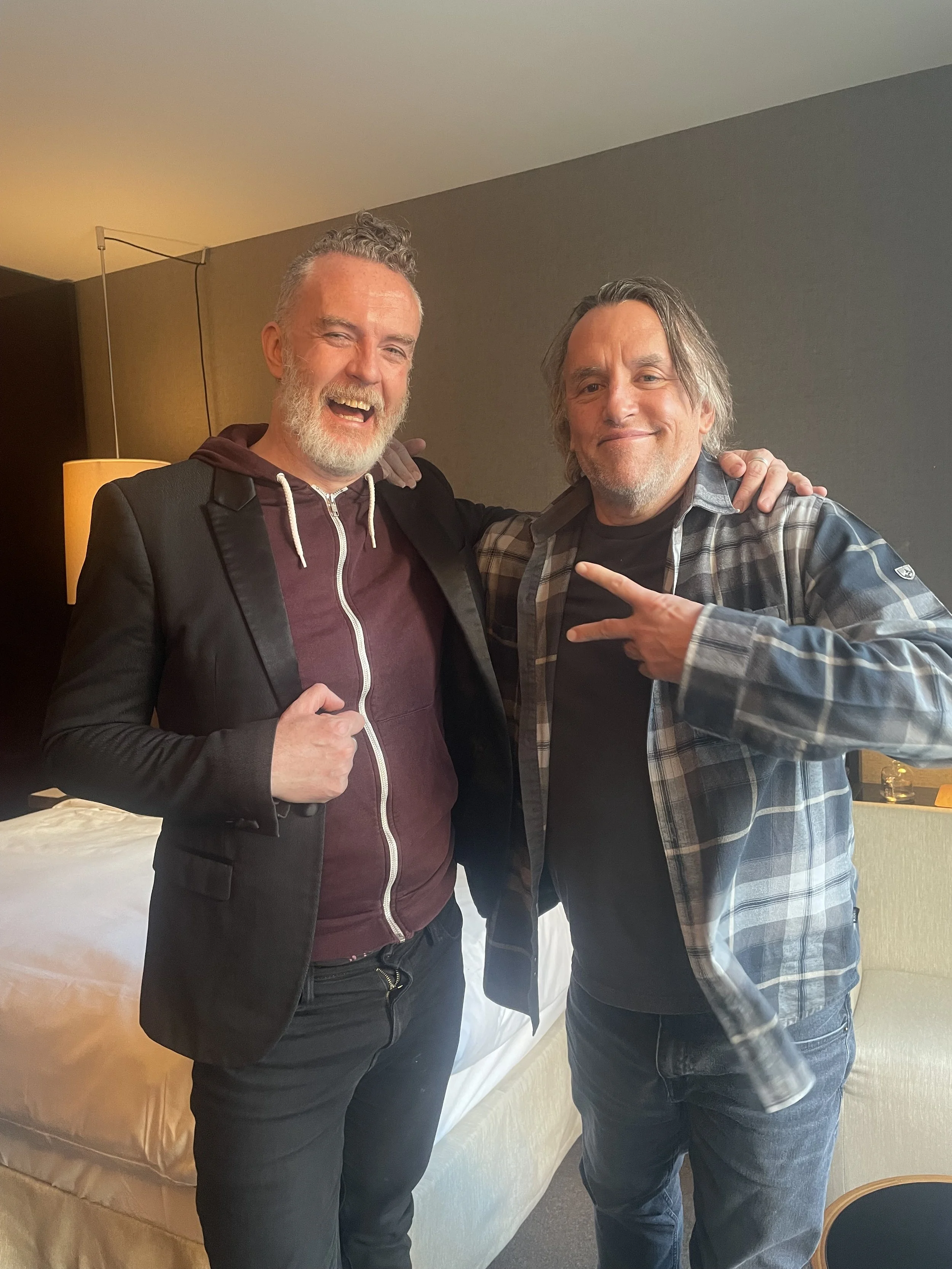
Photo by Stephen A. Russell
Biopics can be brutal, collapsing under the weight of capturing a life well lived in under two hours. Something that Blue Moon steadfastly refuses to do, instead successfully focusing on a defining moment that can speak to the whole.
Linklater credits screenwriter Robert Kaplow, with whom he previously collaborated on Me and Orson Welles, with this laser-focused economy.
“Robert’s a great writer and historian with an old-fashioned wit that’s straight out of the ’40s,” Linklater says. “We bonded over that, and he was surprised I knew all the music. I was that kid into punk rock, yeah, but I also loved the Rogers, Hart and Hammerstein. My mom would play all these Broadway soundtracks.”
Kaplow adapted Hart’s letters to and from student Elizabeth Weiland, here played by The Substance star Margaret Qualley, who holds her own with Hawke. Her co-star agrees with Linklater that the film’s emotional musicality is all there in Kaplow’s script.
“Larry was a closeted homosexual, but he wrote these passionate love letters to this young woman, and it hypnotised Robert,” he says. “Larry’s distracting himself constantly and, to me, that’s the way he, and we, cover up pain.”
An avid reader and writer, Hawke encourages all emerging actors follow suit. “Acting is an interpretive art,” he says. “It’s about sharing writing with an audience, and when you try to write, you learn how difficult it is to express yourself succinctly and clearly in a way that might be interesting to another human being.”
That skill translates into performance. “Your respect for writing goes up, so you study your lines differently, asking better questions.”
Hawke also recommends working with friends, with a caveat. “We often present our best self to people we just met, and don’t treat the people we’re closest to with the same respect as we do a new lover,” he says. “I try not to take Rick for granted. I’m really surprised that he’s still interested in working with me. I can’t believe he’s not bored to tears. He’s seen every trick in my book.”
Going off book
Given how long indie films take to get up, it’s a strange coincidence that Nouvelle Vague, Linklater’s similarly long-gestating tribute to Jean-Luc Godard’s Breathless, arrives in Australian cinemas within a month of Blue Moon.
“It’s so weird, how life unfolded, but I couldn’t be happier,” Linklater says. “They’re very different films, but kind of companion pieces. One’s about the start of a career, and the other about the end.”
Speaking of ends, Linklater insists the oft-heralded death of cinema has been greatly exaggerated. “I started a film society in Austin 40 years ago, and we’re doing better than ever,” he says. “We have two screens, and we’re gonna add another. Cinema has a way of renewing itself. The human spirit wants this.”
It’s where the magical mixes with the mundane. “The best experience I’ve ever had in a cinema was watching David Lynch’s Blue Velvet at two in the afternoon with about six other people,” Linklater says.
“I don’t even know these people, but I’ll never forget that experience. You yearn for that communal experience, then you walk out into a mall.”